
In the Heat of the Moment: Getting through a heat wave.
Hot again! Here's some common sense about dealing with the heat.

Hot again! Here's some common sense about dealing with the heat.
The best defense is prevention.
• Drink more fluids, regardless of your activity level. Don’t wait until you’re thirsty to drink. Even if you remain indoors and limit your activity, your body still needs to replace lost fluids, salt and minerals. Make an extra effort to drink a minimum of six to eight 8 oz. glasses of cool fluids daily.
• During heavy exercise in a hot environment, drink two to four glasses of cool fluids each hour.
• Alcoholic beverages are not something you should drink in quantity, and they're actually not helpful at all in hydrating your body.
• Don’t drink liquids with large amounts of sugar or caffeine–these actually cause you to lose more body fluid. Also, avoid very cold drinks, because they can cause stomach cramps.
• Stay indoors and, if at all possible, stay in an air-conditioned place. If your res hall does not have air conditioning, hey, this is a great time to introduce yourself to the Library!
• Electric fans may provide comfort, but when the temperature is in the high 90s, fans will not prevent heat-related illness. Taking a cool shower, or moving to an air-conditioned place is a much better way to cool off.
• Wear lightweight, light-colored, loose-fitting clothing.
• Dunk yourself: Find the hours of the on-campus pool, or the local public pool.
If you must be out in the heat
• Try to limit your outdoor activity to morning and evening hours. You have to get from class to class, but don't hang out outside.
• Cut down on exercise. If you must exercise, drink two to four glasses of cool fluids each hour. A sports beverage can replace the salt and minerals you lose in sweat.
• Try to rest often in shady areas.
• Protect yourself from the sun by wearing a wide-brimmed hat (also keeps you cooler) and sunglasses and by putting on sunscreen of SPF 15 or higher (the most effective products say “broad spectrum” or “UVA/UVB protection” on their labels).
What can happen if you’re not careful?
The most common heat-related conditions are heatstroke, heat exhaustion, heat cramps, sunburn and heat rash. Heatstroke and heat exhaustion are the most serious conditions.
What is heatstroke?
Heatstroke occurs when the body becomes unable to control its temperature: the body's temperature rises rapidly, the sweating mechanism fails and the body is unable to cool down. Body temperature may rise to 106 degrees F or higher within 10 to 15 minutes. Heatstroke can result from overexposure to direct sunlight, with or without physical activity, or to very high indoor temperatures. It can cause death or permanent disability if emergency treatment is not given.
What are the symptoms of heatstroke and how are they treated?
Symptoms of heatstroke include an extremely high body temperature (above 103 degrees F, orally); red, hot and dry skin; rapid pulse; throbbing headache; dizziness; nausea; confusion; and unconsciousness. If symptoms of heatstroke are present, find a cool place, preferably an air-conditioned indoor setting. Outside, find a spot in the shade. Put the person in a semi-sitting position. Loosen his or her clothing and bathe the head and body with cold water. Seek medical attention immediately.
What is heat exhaustion?
Heat exhaustion can result when too much time is spent in a very warm environment, resulting in excessive sweating without adequate fluid and electrolyte (salt and minerals) replacement. This can occur either indoors or outdoors, with or without exercise.
What are the symptoms of heat exhaustion and how are they treated?
Symptoms of heat exhaustion may include dizziness, headache, nausea, abdominal cramps, shallow breathing, cool and clammy skin, muscle tremors and heavy perspiration.
A person suffering from heat exhaustion should be moved to an air-conditioned environment if possible.
• If outside, move the person to a shady spot.
• Loosen the person's clothing and encourage him or her to drink cool, non-alcoholic, decaffeinated beverages.
• Keep the person quiet.
It may be necessary to seek medical attention if symptoms worsen or last longer than one hour or if the person has heart problems or high blood pressure. If left untreated, heat exhaustion may progress to heatstroke.
Information from the CDC was used extensively in preparation of this story.

The Thrill is Gone: Sean McDowell on happiness vs. blessedness.
"The paradox of happiness is that if we seek it, we won’t find it…"

Maybe you've felt it before; that odd feeling when something you used to enjoy just isn't so much fun anymore. It could be anything, from bodysurfing to a hot fudge sundae to a new episode of your favorite show...it's hard to say why, but the thrill is gone. You need something new to give you that same rush.
Many of our consumerist tendencies are attempts to respond to this loss of thrill. Phone not fun anymore? Buy a new one. Car doesn't thrill you anymore? Buy a new one. Your partner doesn't give you a rush anymore? Get a new one.
But, to misquote Shakespeare, what if "the fault is not in our stuff, but in ourselves"? What if we've settled for the adrenalin/dopamine/endorphine rush of "happy" instead of the deeper, abiding "blessed" which only comes by focusing on others, not ourselves?
In this post from Talbot's "The Good Book Blog," Apologetics prof (and Biola alum) Sean McDowell explains the confusion between happinessand blessedness, and how our expectations about one can affect the other. "The paradox of happiness is that if we seek it, we won’t find it," says McDowell. "True happiness comes when we stop focusing our own feelings, and lovingly seek the best for others."
So take the 3 minutes to read it...for the sake of someone else in your life.

Learning to Cry: Surviving and learning from grief.
Most of us don't get taught how to grieve. Maybe it's not something that can be taught; maybe it's something you have to go through to really get. But hearing someone else's story can go a long way.
"Believe me, every heart has its secret sorrows, which the world knows not, and oftentimes we call a man cold, when he is only sad.” -Longfellow.
Most of us don't get taught how to grieve. Maybe it's not something that can be taught; maybe it's something you have to go through to really get. But hearing someone else's story can go a long way.
Author/speaker Brooke Mardell nearly lost her husband Jason to a heart attack a few years ago, and she came to Biola to talk about what grief is like and what she learned.
Most importantly, grief is real life; there is no Biblical guarantee that we will avoid grief (in fact, we seem to be promised the exact opposite).
And if we don't talk about it before it touches our lives (because it will), it can push us deep into ourselves, and cause us to put on fake smiles and Christian "happy talk." And because we've never talked about it, when it happens it feels strange and abnormal and causes us to question God's goodness and trustworthiness and even His existence...questions we might be afraid to say out loud at a place like Biola.
But for Mardell, despite her fear, "I wasn't going to hear the answers until I was willing to ask the questions."
"In some ways, there's no 'getting over' griefs that come into your life," says Mardell. In some things, grief is for a lifetime; loss is real. As Anne Lamott said, "It’s like having a broken leg that never heals perfectly – that still hurts when the weather gets cold, but you learn to dance with the limp.”
But can good that comes out of grief? For Mardell, grief has been a chance to see herself and God differently, in a more honest and genuine way. Grief is a "massive rainstorm that comes and washes away the pretense of who we are, and maybe the pretense of who we think God is."
She also offers practical wisdom about allowing for mystery and unanswerable questions and rawness, about how to avoid unhelpful advice and quick fixes, how to use the lament Psalms to turn complaint to adoration, and how to be a safe person for others who are grieving, whether believers or unbelievers.
Grief will indeed find all of us...here's 26 minutes of wisdom on how to live with it.

True Love...Dates? Why dating at a Christian college is so weird (Pt. 2).
Before I try to figure if the other person is right for me, maybe I should ask myself, "Am I engaging in healthy relationships? Am I a healthy person? Do I have a healthy relationship with God?”

In Part Two of this CMR podcast (Part One is here) about Christians and dating, guest Debra Fileta* focuses on where our own lives should be, before we think about starting a relationship with someone else. The discussion also steers into the contentious area of "roles" in marriage, and concludes with some wisdom about both physical and emotional intimacy.
For Debra, the framework that all dating questions fit is "Am I engaging in healthy relationships? Am I a healthy person? Do I have a healthy relationship with God? Those are the three central questions that I'm trying to get people to zoom out and answer....Christians are good at the cliché of saying, "Oh Christ is the center of our relationship." What does that really mean? How do you break that down and make it a practical thing?"
Are Christians waiting too long to get married, and thus causing themselves problems? Debra finds that there is no 'best age' to get married: "It does take maturity, and maturity comes from different things....maturity comes from life experience, maturity comes from the people that you're exposed to, maturity comes from the Holy Spirit and the depth of your relationship with the Lord. What it comes down to truly isn't necessarily a number."
Chris, Tim, and Debra also get into whether men and women are as different as we've been led to believe. Are men really from Venus and women from Mars? "I feel like we put [on] these negative stereotypes and we sort of make them bigger than they are," says Debra. "When I look at scripture, I don't see much of that going on. I see Christ calling us to the same kinds of things...at the end of the day we're all called to health and wholeness in Christ.”
What about emotional intimacy? We've been told to set clear boundaries with physical intimacy, but surely emotional and spiritual intimacy is a positive thing, right? Be wise, says Debra: "I think sometimes we take spiritual intimacy and we introduce it into a dating relationship far too early...before trust has even been earned, before commitment has even been discussed and we end up with a broken heart and a broken spirit....We want to connect as fast as we can, but nothing will ever replace your intimacy with God and that's what's going to give you more and more wisdom and more and more answers along the way."
Want to hear the whole thing? It's 26 minutes of real wisdom.
Listen to the whole podcast here
* Debra Fileta is a professional counselor, national speaker, and creator of TrueLoveDates.com where she reaches over 2 million people a year with the message that "healthy people make healthy relationships." She's also the author of the book True Love Dates: Your Indispensable Guide to Finding the Love of Your Life, where she writes candidly about dating, relationships, and how to find true love. You may also recognize her from her 200+ articles at Relevant Magazine, Crosswalk.com, and all over the web.

True Love...Dates? Why dating at a Christian college is so weird (Pt. 1).
In a culture that condones and even encourages the hookup, why is dating for Christians such a taboo subject?

In a culture that condones and even encourages the hookup, dating for young Christians is often a taboo subject; it's either avoided completely, or only acceptable with a person you're "intending to marry."
This makes living around hundreds of other young single people at college a very confusing and anxiety-producing thing.
But, of course, it's too weird to talk about.
So, of course, Drs. Chris Grace and Tim Muehlhoff will talk about it. In this edition of the CMR podcast, they sit down with Debra Fileta, author of True Love Dates: Your Indispensable Guide To Finding the Love of Your Life, to discuss why dating doesn't happen on Christian campuses, who can initiate, having realistic expectations, working on your own baggage, and spotting red flags.
After 11 years at Biola, Tim has observed something that nearly every undergrad already knows, that "...the way modern Christian college students navigate this is, there is virtually nodating that happens on campus. And what little dating that doeshappen goes from zero to a hundred in a heartbeat."
Why? As Debra sees it, given the excesses of the culture around us, "there's this fear of even interactingwith the opposite sex....We want to honor God, we want to do what's right, but really deep deep down, I think there's also a fear of failure. We don't want to mess this up..."
Another of Debra's observations concerns a loss of perspective: "I think we elevate dating to the level of marriage. We take it just as seriously, and asking someone out for coffee becomes equivalent to a marriage proposal: "I have to take this seriously," even though it's really just coffee. I think we've lost the art of having relationships in a healthy way with the opposite sex that aren't even romantic."
And we haven't even gotten to the part about who can (should?) initiate, how social media affects our expectations and standards, and how becoming an emotionally healthy person is key to having a healthy relationship. It's worth the 27 minutes (and after that, Part Two is here).
Listen to the whole podcast here
Debra Fileta is a professional counselor, national speaker, and creator of TrueLoveDates.com where she reaches over 2 million people a year with the message that "healthy people make healthy relationships." She's also the author of the book "True Love Dates: Your Indispensable Guide to Finding the Love of Your Life," where she writes candidly about dating, relationships, and how to find true love. You may also recognize her from her 200+ articles at Relevant Magazine, Crosswalk.com, and all over the web.

Fred Sanders on The Trinity and "The Shack": Does it matter what we believe (as long as we're sincere)?
The Shack was one of the best-selling novels of 2008, and has recently been released as a motion picture. Does it tell a story worth hearing?
It matters what we believe, not just that we believe; our faith certainly involves commitment, love, and other "matters of the heart," but it is not a faith without content. Nearly every church has a "Doctrinal Statement" or something similar. The early history of the Church is a history of church councils, creeds, and statements...all attempts to lay out doctrine about God; what is true, what is false.
And while it is a book of fiction, The Shack has no shortage of preaching and doctrine, though the book itself would call "doctrine" a bad word.
The Shack was one of the best-selling novels of 2008, and has recently been released as a motion picture. It's the story of a man who has suffered a catastrophic loss, and in the midst of his anger and bitterness gets a mysterious note from an unknown "Papa," which leads to a prolonged face-to-face encounter with God in trinitarian form. Author William Paul Youngpresents God in very winsome but often unexpected ways; God the Father is cast as a warm-hearted African-American woman who calls herself "Papa," Jesus is a middle-eastern carpenter (no surprise there!), and the Holy Spirit is seen as an Asian woman named Sarayu.
The central concern of The Shack seems to be how to make God relatable in the midst of suffering. Dr. Fred Sanders, Mike Ahn's guest on The Biola Hour, believes that Young's key concern as an author was, "In order to deal with the problem of suffering, what kind of message about the Trinity would I need to bring?"
"For people who haven't focused any attention on the tri-unity of God," says Sanders, "[The Shack] is a strong prompt to do so. But what you get [is] a serious reduction of what Scripture is trying to tell us about who God is. It goes so far in the direction of wanting to have a relatable Trinity that you don't have a worship-able Trinity."
Want to see more, both about the book/movie and about the magnificent mystery that is the Trinity? Here's Sanders and Ahn, from March 3, 2017:

Theater of the (Old) Mind
I try not to bore you with too many of my quirky hobbies, but I really do like Old Time Radio.
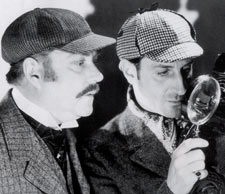
Nigel Bruce (Watson) and Basil Rathbone (Holmes)

Conrad (top left) and the main Gunsmoke cast

Jack Webb

The cast of Superman

Welles as The Shadow

Jack Benny and Fred Allen

Edward R. Murrow

Roosevelt
I try not to bore you with too many of my quirky hobbies… but my dear friend Dale sent me a link http://www.old-time.com/mcleod/top100.html to a list by radio historian Elizabeth McLeod of the 100 most significant “moments” in radio. Now, I really really like old time radio (OTR), and thousands of hours of it can be found online. Almost all of it is in public domain now (with notable exceptions like The Lone Ranger, The Shadow, any BBC stuff, and anything post-1962).
Many many of the radio things she mentions are unfortunately lost, or otherwise not available to the OTR web community. But I wanted to talk about some of her entries that I am conversant with:
#98 SHERLOCK HOLMES is indeed made for radio... it’s all exposition and verbal banter and deduction. The first ongoing series was the 1939-1946 Rathbone and Bruce version, which is pretty corny but still entertaining; their American successors don’t fare as well. The really good productions are British; John Gielgud and Ralph Richardson as Holmes & Watson, for goodness’ sake! And the late-90s productions for BBC-4 with Clive Merrison and Michael Williams (later Andrew Sachs) are the defining work; they are beautifully written, elaborately produced, wonderfully performed, and bring these characters so richly to life that it’s hard to go back and listen to the older stuff.
#75 GUNSMOKE is my favorite radio drama... If all you saw was his “Cannon” TV days, you wouldn’t appreciate what a really really good actor William Conrad was. His Matt Dillon is a marvel of understated complexity, and he did it all with just his voice. Like McLeod’s listing says, this is not a western where the good guys always win and there’s trumpet fanfare at the end. If I was one o’ them cinema historian guys, I’d say that the ‘anti-hero’ and ambiguity of so many late-60’s-early-70’s films goes directly back to the radio version of Gunsmoke. Lots of times Dillon has to choose between bad and worse. Not Ronald Reagan’s kind of western.
#69 DRAGNET is of course a blast... It’s really no different than the TV show, except there’s no crazed drug smokin’ hippies turning on by tuning out, man (“is that right, fella?... Well listen up, you forgot one thing...”). Of course, Joe Friday is single and lives with his mom, who calls him “Joseph.” And he stays out on stakeouts with his partner Frank Smith until all hours. And he scoffs every time good old married guy Frank tries to fix him up with a date. But he’s not gay... Clear?!? Not gay!!! He’s... he’s... metasexual!
#66 SUPERMAN is about what you’d expect... except (as noted in McLeod) there are many less-than-subtle messages (in the scripts and in the PSAs done by the cast) against bigotry, intolerance, and hate. It’s truly astonishing. For all the complaints that the right sends up today about the ‘messages’ kids get from Sesame Street, etc., there is no way that this kind of blunt proselytizing would ever be allowed on a kids program today. I don’t know enough about the history of the show to know what the genesis of this was, but it sounds radically out of place in 1946, and (at the risk of overstatement) it makes the movements of the 60’s more understandable with this as a preface...
#53 THE LONE RANGER is, also, about what you’d expect... but with no surprises. Not my favorite, if that’s not heretical to say. It didn’t have the weirdness and camp that makes Superman palatable for an adult. It is surprising how often the bad guy outsmarts LR and he has to go to plan B…
#51 THE SHADOW with Orson Welles. Welles is always fun to listen to... In several of the episodes I have, young Welles seems to believe that great acting requires stepping on the last word of your co-star’s lines, usually Margo Lane’s. By the end of the episode, she’s started stepping on his lines (you can actually hear the frustration) and he’s on hers and neither of them ever gets to finish a sentence. But great hammy stuff for Welles.
#47 LIGHTS OUT, Columbia Workshop, etc.... Some really odd stuff starting to happen here, much more troubling and personal than 99% of TV today. This is the seedbed for Playhouse 90 and Rod Serling and his amazing blend of fantasy and social commentary.
#26 JACK BENNY, FRED ALLEN- Jack is one of my all-time favorites; my parents told me that when I was little I would never miss an episode of his TV show. He generally plays the straight man, letting the chaos flail around him; his only power is that he controls the money, a fact he never lets his cast forget (and vice versa). It’s really situation comedy. Allen’s shows, on the other hand, were much more an odd combination of a sketch comedy that often had an opening monologue, very acerbic and very funny, and very topical, which is why it doesn’t hold up as well, and probably why Allen faded as TV ascended…which is ironic since Saturday Night Live (and now-gone people like Johnny Carson and Jack Parr) owe much to Allen.
#21 LONDON AFTER DARK. I’ve only heard a couple of these, but if you can get your 21st century ears around the idea that this is real, not a drama, they’re amazing. Live “play-by-play” descriptions of bombing raids, shelters, and life in the blackouts. It was led by CBS’ Edward R. Murrow, and backed by a team of notable broadcast journalists (including Larry LeSueur and Eric Sevareid) as well as authors like J.B. Priestly and Vincent Sheean. If the closest thing you’ve come to WW2 is watching war movies, this is the real thing. And if you wondered how England held out so long while waiting for the Americans to come to their senses, you’ll come to understand how damn tough those Brits were.
#8 HINDENBURG DISASTER and #10 WAR OF THE WORLDS: Only 18 months apart, the shocking immediacy of the first added greatly to the incredible-yet-believable drama of the second. I hope my generation isn’t the last to hear and appreciate these icons to the power and intimacy-shared-with-millions magic of radio.
#4 PEARL HARBOR: The halting delivery of a stunned newscaster, breaking in to regular programming; the updates throughout the day describing the extent of the carnage; Roosevelt’s “forever in infamy” speech... That was their 9/11, when nice normal predictable American lives were suddenly dragged into the pain other humans had known for years. And to listen to the newscasts in the weeks and months preceding December 7th, it is stunning for someone my age to understand that it was no sure thing that we were going to battle Hitler and Tojo; there was a real good chance we were going to try and sit it out. Amazing.
And the list rightfully concludes with #1, D-DAY: I’ve only heard the CBS broadcasts, with Collingwood onboard a landing craft at Normandy. To say there’s a difference between the journalists of that day, and the Anderson Cooper’s of today, goes without saying; the difference centers around the inability to get out of the way of the story.

Everything Ruder Than Everything Else
As long as we are a people driven by fear and selfishness, we will also be attracted to hatred and prejudice.
As my friend Dale will tell you, the day after the Don Imus scandal broke, I pretty much knew he was done… that’s nothing to brag about; I had a 50/50 shot, in or out. But this time his stink had gotten fanned into the national a/c system, there was no other big story out there to cover the scent, and between bloggers and YouTube, there are too many noses in the air now to miss the smell. My friend Joe thinks it’s because it was simulcasted on MSNBC; if it had just been radio, it might have gone right by…

Maybe.
This could turn into a rant, and there are others who’ll do that better than I. Let me just respond to a few comments I’ve heard from Imus defenders:
This is an overreaction to a single incident. Even Imus’ apologists are using the words “disgusting” and “reprehensible,” but what they leave out is “and totally in character.” This is not an out-of-the-blue remark for Imus; it’s not unexpected at all. That he got called on it probably shocked the hell out of Mr. Shock-Jock himself.
That Imus is only giving people what they want. Fine, I’ll accept that most humans need their taste and preference meters adjusted; I’m a Christian who believes in total depravity. But I also believe that the goal is upward, not downward, and that playing to our baser instincts is a bad thing to do. See also “Francis, Joe.”
That Imus is not a bad guy. That’s fine; I’ll buy that too. I’m not suggesting he be jailed or exiled or beaten. I’m just saying it’s appropriate that he lost his job. He’ll get another. In fact, he’s probably got a standing offer from Sirius in his desk drawer at home.
That this is a free speech issue. I call BS on that one. Imus has the right to say whatever he wants. He doesn’t have the constitutional right to be paid $10 million a year to say it over 60+ radio stations. Give him a soapbox and a streetcorner and let’s see how many folks think he’s clever.
Maybe I’m overly sensitive because I work around college students all day long. If you’re a politician or an actor, this is part of the deal; taking public abuse and criticism is the flip side of the power and wealthy and fame if you’re Hillary or Barak or Tom or Oprah, or even wannabees like Kato Kaelin or Larry Birkhead. But a bunch of teen-age girls playing basketball? This is a viable target? As I recall, the only email I ever sent to sports talk host Jim Rome was when he was running smack on a 12-year-old girl who had won a spelling bee. I don’t remember exactly what I wrote, but it was something about if this was the best he could do anymore, maybe he could get his old job back introducing the strippers at the Doo-Drop-Inn Gentlemen’s Club (hmm, come to think of it, I don’t think he ever wrote back…).
Tim Rutten has a good take in the LA Times today (http://www.latimes.com/news/nationworld/nation/la-et-rutten13apr13,0,6022815.column), wondering if maybe we have finally satiated our appetites for vile and meanspirited public ‘conversations.’ I wish it were so… but as long as we are a people driven by fear and selfishness, we will also be attracted to hatred and prejudice. During the LA riots, when Rodney King asked, “can’t we just all get along?,” Christian philosopher Dallas Willard wistfully responded, “No, we can’t… not until we become the kind of people who can get along.”

You Must Think the Sun Shines Out of Your MSG
One thing about New Yorkers: they’re often so self-absorbed that it’s hard to know when they’re being sarcastic.

One of the NYT columnists, William Rhoden, suggested the other day (it’s a paywalled story, so I won’t link it) that it would be in the best interests of the NBA for the Knicks to be allowed to ‘write off’ all the ludicrous contracts they’ve provided, so that they can ditch all their stiffs, get under the salary cap (which otherwise won’t happen until 2010), and essentially start over. The argument being, of course, that NY is essential to the NBA’s success, and thus special dispensation is warranted.
One thing about New Yorkers: they’re often so self-absorbed that it’s hard to know when they’re being sarcastic. But I have a solution that doesn’t just reward (and perpetuate) ineptitude; if the Knicks (and the Celtics, and the 76ers, etc.) are so critical to the success of the NBA, why doesn’t the NBA ‘reclaim’ their franchises (buying them back at market value) and put them in the hands of some at-least-semi-competent management? They are franchises, right? If I owned a McDonald’s franchise, and started selling horsemeat quarter pounders, I imagine that McDonald’s would find a way to pull my franchise, for the good of the brand. What these teams have been serving up over the past several years wouldn’t even qualify as horsemeat, although another term comes to mind…
There are drawbacks, of course; the entertainment value of the NBA would certainly drop without the astonishing antics of Isiah Thomas, James Dolan, Danny Ainge, Billy King, the Maloof brothers, Billy Knight, Kevin McHale, whoeveris running the Seattle franchise (if anyone), and of course the inimitable Donald Sterling. But that’s too much ineptitude spread across too many teams; I would suggest to David Stern that he designate two franchises as the official league buffoons (my votes are the Knicks and the Celtics, but I’m biased), relocate all of the above-named suspects therein, and tell the rest of the league to start taking this seriously.
When I Look in the Mirror:

Have you noticed that, as the chastened GWB moves closer to his father’s more moderate policies and stances, he’s also taken on some of his gestures?
I can’t wait to hear him say ‘prudent.’ But come to think of it, I don’t think that’s a concept he’s familiar with.
And a Belated Closing
Not that there’s no value at all to the NYT; check this out [paywalled], in case you missed it on Mother’s Day. God’s pretty smart, you know. Genesis 5:2 says that “He created them male and female. He blessed them and called them humans when he created them.” I just don’t think a male, left to his own devices, would’ve made a different choice… and would have been much the poorer for that choice.

Social Justice: Either/Or or Both/And?
“…whether they will finally be lost or saved, you are expressly commanded to feed the hungry, and clothe the naked. If you can, and do not, then whatever becomes of them, you shall go away into everlasting fire.”

Joseph Loconte
My friend Joe sent me a link [http://www.opinionjournal.com/taste/?id=110010062] the other day, asking me what I thought about the whole idea of the ‘social gospel.’ The link is a WSJ article by Joseph Loconte of the Ethics and Public Policy Center, discussing the legacy of the ‘founder’ of the social gospel, Walter Rauschenbusch. I will not attempt to recap, other than to say that it is a remarkably precise analysis of the weaknesses of Rauschenbusch’s work. I have great affection for the brothers (Campolo, Wallis, Hauerwas) cited as lauding Rauschenbusch, but I suspect they are more familiar with his legacy than his actual writing.

Walter Rauschenbusch
As Loconte points out, Christianity does not have to be distorted in order to produce works of social justice; indeed, it cannot produce anything if it is eviscerated: “The Christian confession of faith, by itself, offers no guarantee that either individuals or societies will be transformed. But, for believers, not even the smallest steps forward can be taken without it.” This echoes my favorite Dallas Willard quote; in responding to Rodney King’s mid-L.A.-riot plea of “Can’t we just all get along?”, Willard replied, firmly but perhaps wistfully, “No, we can’t… not until we become the kind of people who can get along.” Social change will not occur without personal, spiritual change.
The typical response of the evangelical church today to that last statement, however, makes the lionizing of Rauschenbusch understandable. While it might make them uncomfortable to admit it, for most evangelicals, social change is not only secondary, it is unimportant or even the wrong direction. Any time or resources spent on justice, reform, or economic efforts would be better spent on evangelism.

John Wesley
These are not new concerns; they surfaced even in the time of John Wesley, and he had a stinging reply, in reacting to the questions that Matthew 25:31ff raised. When asked “what does it avail to feed or clothe men’s bodies, if they are just dropping into everlasting fire?”, Wesley would respond, “whether they will finally be lost or saved, you are expressly commanded to feed the hungry, and clothe the naked. If you can, and do not, then whatever becomes of them, you shall go away into everlasting fire.” It is not evangelism or social action, it is evangelism and social action. I am encouraged that this generation of college students seems less tied up with either/or statements, and are willing to embrace the both/and, because the Christian work in this world is clearly a both/and.